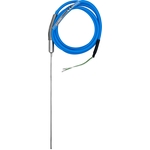
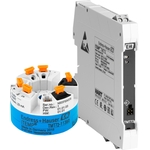
Blast furnace copper staves protect the furnace shell and enhance wear resistance, but as the refractory lining erodes, more heat reaches the stave and its temperature rises. Temperature is one of the earliest indirect indicators of furnace condition during operation. iTHERM CableLine TSC310 cable probe, combined with the iTEMP TMT72 temperature transmitter, delivers robust, continuous stave temperature measurement under harsh conditions, helping operators detect leaks, blocked channels and refractory wear early, and avoid overheating, stave damage and hydrogen attack.
The benefits: Earlier warnings, safer operation and reliable production
Early warning
of refractory erosion & wear
Leak & blockage detection
in cooling water channels
Potential for longer furnace life
- avoid stave damage & downtime
Continuous stave temperature monitoring turns an otherwise invisible furnace condition into an early-warning system.
Cooling system protection:
Water leaks
Blocked pipe
Insufficient water flow
Stave surface protection:
Copper stave erosion
The challenge: Assessing furnace condition without internal inspection
Blast furnace copper staves are a cooling solution designed to enhance wear resistance and prevent shell deformation. As the refractory lining wears away, more heat reaches the stave. Because the inside of a running furnace cannot be inspected directly, a rising stave temperature is one of the most important indirect indicators of refractory wearing away or erosion, allowing operators to identify problem areas long before a breakdown occurs.
Reliably capturing this signal is demanding: sensors must withstand large temperature swings together with fluctuating cooling water pressure and inlet/outlet temperatures across different furnace zones (belly, bosh, cohesive zone, etc.).
Typical process conditions:
Cooling water inlet temperature: 25-35 °C
Cooling water outlet temperature: 35-60 °C
Cooling water pressure: 33-45 bar
Stave temperature (depending on location): 50-250 °C
Our solution: Robust stave temperature monitoring
To meet these demanding requirements, Endress+Hauser equips the cooling staves with iTHERM CableLine TSC310, an industrial TC cable probe with quick-disconnect plugs that simplify installation. In this application, the OEM or plant builder typically specifies that a thermocouple (TC) measuring principle should be used, which makes TSC310 is the standard choice here.
4–20 mA / HART output is the established communication standard in the Mining, Minerals & Metals industry, which is why iTEMP TMT72 is a good fit: it is a HART-compatible DIN-rail transmitter that converts the thermocouple signal and ensures reliable communication with the control system. In addition, the SmartBlue App lets operators visualize process values directly on a mobile device, without additional wiring.
Together, these components form a temperature monitoring system that enhances process efficiency, improves safety, and supports consistent operation of the furnace.
Contact us
Are you interested in our offering? Would you like to discuss your application?
Fast, continuous hydrogen measurement in natural gas pipelines enables safe blending, quality compliance and dynamic control using Raman spectroscopy - without consumables or flaring
Biomethane quality analysis for safe and compliant gas injection
Ensure reliable biomethane quality with fast, accurate online measurement of H₂S, water dew point and critical parameters for safe grid injection and efficient operations.
Protect reverse osmosis membranes with online water quality monitoring for desalination
Reliable online water quality monitoring to protect RO (Reverse Osmosis) membranes, reduce cleaning effort, and extend membrane lifetime in desalination and water reuse applications
Detection of leakages in cryogenic tanks (LNG, ethylene, LPG, and ammonia)
Detect cryogenic tank leaks early and stay in control. Endress+Hauser provides continuous, highly reliable temperature monitoring to protect people, assets, and critical infrastructure.